 Gair, Gair, Conason, Rubinowitz, Bloom, Hershenhorn, Steigman & Mackauf Home
Valhalla Metro-North Train Crash: How Our Attorneys Established Railroad Liability
On February 3, 2015, a Metro-North commuter train traveling through Valhalla, New York, struck an SUV at the Commerce Street railroad crossing. The catastrophic collision claimed the lives of the SUV driver and five train passengers and left dozens of others injured.
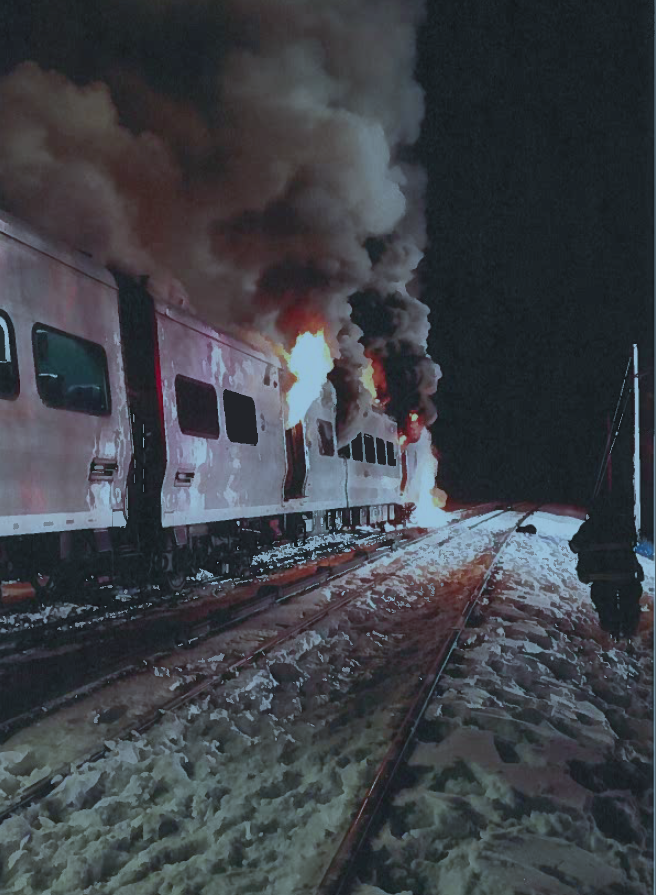
What followed was nearly a decade of extraordinarily complex, fiercely contested litigation involving railroad operations, train speed, electronic event-data evidence, the design and safety of Metro-North's third-rail system, and fundamental questions of negligence and responsibility.
At the center of this litigation were Ben B. Rubinowitz and Richard M. Steigman of Gair, Gair, Conason, Rubinowitz, Bloom, Hershenhorn, Steigman & Mackauf, who were unanimously selected by the attorneys representing the victims to serve as lead trial counsel in the critical liability phase of the case.
Their selection reflected the confidence of their fellow trial lawyers in their courtroom abilities, strategic judgment, creativity, and mastery of trial advocacy.
The challenge was formidable. The initial federal investigation had largely attributed responsibility for the collision to the SUV driver. Overcoming that conclusion and establishing Metro-North's substantial responsibility demanded far more than a conventional presentation of evidence. It required the ability to uncover and develop compelling proof, master highly technical subject matter, expose weaknesses in opposing expert opinions, and transform complex scientific and engineering evidence into a clear, persuasive narrative that a jury could understand and embrace.
This was trial advocacy at its highest level, a demonstration of the extraordinary preparation, ingenuity, strategic thinking, and courtroom excellence required to prevail in a case where the prevailing narrative initially appeared to favor the defense.
Through meticulous preparation, innovative trial strategy, sophisticated use of demonstrative evidence, and incisive cross-examination, Rubinowitz and Steigman challenged the conclusions that had shaped the case from its inception. Their ability to simplify complicated technical concepts, confront opposing experts with critical evidence, and develop a compelling theory of liability became central to the presentation.
Following a grueling six-week trial, the Westchester County jury found Metro-North 71% responsible for the collision and SUV driver Ellen Brody 29% responsible.
The litigation ultimately resulted in a global settlement exceeding $182 million for the families of five passengers who lost their lives and the dozens of passengers who suffered injuries.
Yet the magnitude of the financial recovery tells only part of this remarkable story.
The true significance of this case lies in the quality of the trial advocacy that produced the liability verdict. It illustrates how exceptional trial lawyers combine intellectual rigor, imagination, technical mastery, and the art of persuasion to overcome seemingly insurmountable obstacles. It demonstrates that outstanding results are not achieved through preparation alone, but through the creativity to see what others have missed, the judgment to recognize what matters most, and the courtroom skill to make complicated evidence understandable, memorable, and convincing.
In the video to the right, Ben Rubinowitz takes viewers behind the scenes of this extraordinary trial, explaining the critical evidence, innovative strategies, and powerful cross-examinations that helped transform a seemingly unfavorable case into a landmark plaintiff's victory. It is a compelling examination of the art of winning through excellence in trial advocacy.
The Valhalla Metro-North Train CrashOn the evening of February 3, 2015, Ellen Brody was driving in Westchester County after traffic had been diverted from the Taconic State Parkway.
She was unfamiliar with the area and encountered the Commerce Street railroad crossing in the dark.
According to the evidence discussed by Rubinowitz, Brody's vehicle stopped near the railroad tracks and the crossing gate came down onto the rear portion of her vehicle. She exited the SUV, apparently attempting to understand what had happened, before returning to the vehicle.
She then moved forward onto the tracks.
A Metro-North train traveling toward the crossing struck the SUV at approximately 59 miles per hour.
But the impact between the train and the vehicle was only the beginning of the catastrophe.
Why the Third Rail Became a Critical Part of the CaseMetro-North uses a raised third-rail system that provides electrical power to its trains.
After the train struck Brody's vehicle, portions of the third rail entered the vehicle and penetrated the passenger compartment of the first train car.
Multiple sections of rail were driven into the train. The collision also ruptured the SUV's fuel system, contributing to a devastating fire inside the first car.
The plaintiffs' attorneys investigated whether the third-rail system performed as it should have during the collision.
A central issue became whether components of the system were intended to break away, or be “frangible”, when struck.
During the trial, Rubinowitz obtained testimony from a Metro-North witness knowledgeable about the third-rail system acknowledging that the rails were supposed to break away.
They did not.
Instead, sections of rail entered the passenger compartment.
This evidence became an important component of the plaintiffs' product-liability case and their effort to explain why an initial collision between a train and an SUV became a mass-casualty disaster.
The Case Began With a Major ObstacleThe plaintiffs did not enter the litigation with the benefit of an investigative report blaming Metro-North.
The National Transportation Safety Board investigated the accident and initially attributed responsibility to Brody while finding no fault on the part of the train operator.
For the attorneys representing the passengers and their families, that meant the case could not simply rely on the initial government investigation.
The evidence had to be examined independently.
The trial team analyzed photographs, railroad operating rules, witness testimony, expert evidence, train-performance data and information contained in the train's event data recorder.
The question became not merely why Brody's vehicle was on the tracks.
It became:
What did Metro-North's engineer see, when did he see it, and what did he do after seeing it?
What Did the Train Engineer See?One of the most important issues involved what Metro-North engineer Steven Smalls observed as the train approached the Commerce Street crossing.
According to testimony discussed by Rubinowitz, Smalls saw something ahead that appeared “shiny and black.”
He did not believe it was an animal.
When questioned about what else the object might have been, he acknowledged that he could not think of anything other than a vehicle.
The observation occurred while the train was still a substantial distance from the crossing.
Yet rather than slowing the train, the evidence showed that the train continued to accelerate toward the crossing.
That fact became the foundation for one of Rubinowitz's principal trial themes:
Slow down. Speed kills.
“With Doubt and Uncertainty, Take the Safest Course”Complex cases often involve thousands of pages of technical documents, expert opinions, regulations and data.
A central part of trial advocacy is turning that complexity into a principle a jury can evaluate.
In the Valhalla case, the plaintiffs were able to use Metro-North's own operating principles.
Rubinowitz explained that railroad employees were instructed that when confronted with “doubt and uncertainty,” they must take the safest course.
That rule became another central trial theme.
If the engineer saw an unidentified object near a railroad crossing and believed it might be a vehicle, the plaintiffs argued, the safest course was to slow the train.
Instead, the train continued to accelerate.
The trial therefore focused not only on what the engineer ultimately knew, but what a reasonably careful train operator should do when confronted with uncertainty while responsible for hundreds of passengers.
645 Passengers Placed Their Trust in the RailroadThe Metro-North train was traveling from Grand Central Terminal toward Westchester during rush hour.
Approximately 645 passengers were aboard.
During closing argument, Rubinowitz focused the jury on the trust passengers place in professionals responsible for their transportation.
Passengers generally do not investigate the qualifications or safety record of the engineer before boarding a commuter train. They rely on the railroad and its employees to operate the train safely.
Rubinowitz described that relationship to the jury as one of “faith and trust.”
That framing brought the case back to a basic question:
When an engineer responsible for hundreds of passengers sees something unusual near a crossing, what does safety require him to do?
The Train's Event Data Recorder Provided Objective EvidenceOne of the most important pieces of evidence was the train's event data recorder, sometimes described as the railroad equivalent of an airplane's black box.
The device recorded detailed information about the train's operation, including speed, braking and horn activity.
The plaintiffs retained experts to analyze the data and reconstruct the train's movements as it approached the Commerce Street crossing.
This allowed the trial team to compare witness testimony with objective electronic evidence.
For example, the engineer had previously described sounding the train's horn frantically after observing the object ahead.
The event-data evidence became important in examining whether that description was consistent with what actually occurred.
The recorder also provided precise information concerning the train's speed.
In catastrophic transportation litigation, this type of objective evidence can be crucial. Memories can change and witnesses can disagree. Electronic data can provide an independent record of what a vehicle or train was actually doing in the seconds before a collision.
Cross-Examining the Train EngineerRubinowitz spent approximately three days cross-examining the Metro-North engineer.
One recurring issue became the engineer's inability at trial to recall information concerning distances, actions and events he had previously discussed.
Rubinowitz used those answers to challenge the credibility and reliability of the testimony.
Among the issues explored was the distance from which the engineer first observed the unidentified object ahead of him.
The engineer had previously provided information concerning that distance to investigators. At trial, however, repeated questions concerning the distance frequently produced variations of the answer:
“I don't know” or “I don't recall.”
Credibility became an important issue for the jury.
A Passenger's Testimony Challenged the Engineer's AccountThe plaintiffs also presented testimony from a young nurse who had been riding in the first car of the train.
According to Rubinowitz's account of the trial, she described assisting people after the collision.
She also testified about seeing the engineer leave his compartment.
Her account became important when compared with testimony concerning what the engineer claimed to have done immediately after the crash.
The contrast illustrated why independent witnesses can become critical in complex litigation.
A case is rarely established by a single document or witness. Attorneys must compare testimony against physical evidence, electronic records and the accounts of other people who observed the event.
Cross-Examining the Railroad's ExpertAnother important moment came during Rubinowitz's cross-examination of a defense railroad expert.
The expert had prepared an approximately 60-page report concerning the collision.
Rubinowitz first established that the expert considered his work accurate, comprehensive and reliable.
He repeatedly used four words to describe the standard the expert claimed for his analysis:
Full. Fair. Thorough. Complete.
Rubinowitz then examined calculations contained in the report.
One diagram indicated that the train had traveled approximately 228 feet in one second.
That calculation would translate to approximately 155 miles per hour, far beyond the train's actual speed.
The expert eventually acknowledged that the figure was an error.
Rubinowitz then turned to another important inconsistency.
One portion of the expert's report referred to an impact speed of approximately 59 miles per hour.
Another portion referenced approximately 54 miles per hour.
That difference mattered because testimony indicated that a train traveling at the lower speed would have had additional time and distance to avoid the consequences that followed.
The cross-examination demonstrated why every calculation, chart, diagram and assumption in an expert report must be examined rather than simply accepted because it carries an expert's name.
Could Slowing Down Have Changed the Outcome?The plaintiffs did not argue that Ellen Brody was completely without responsibility.
Instead, they asked the jury to consider whether Metro-North's conduct also contributed to the catastrophe.
The evidence presented at trial supported the argument that slowing the train could have changed what happened.
According to the testimony described by Rubinowitz, even a relatively small reduction in speed could have provided additional time for Brody to clear the crossing or could have changed whether the train reached the third rail after striking her vehicle.
That issue became fundamental to the plaintiffs' case.
The question was not simply whether the SUV should have been on the tracks.
It was whether Metro-North had an independent responsibility to respond safely to a danger its engineer could see developing ahead.
The Jury Finds Metro-North 71% ResponsibleAfter the six-week liability trial, the Westchester County jury rejected the contention that responsibility rested solely with Ellen Brody.
The jury allocated:
71% of the responsibility to Metro-North
and
29% of the responsibility to Ellen Brody.
The verdict represented a significant change from the initial narrative surrounding the accident and established Metro-North as primarily responsible.
It came after nearly a decade of litigation and an extensive examination of railroad operations, engineering, electronic data, expert testimony and witness credibility.
More Than $182 Million Recovered for Victims and Their FamiliesFollowing the liability verdict, the Valhalla litigation ultimately resolved through a global settlement exceeding $182 million.
The settlement provided compensation to the families of five train passengers who were killed and dozens of passengers who suffered injuries.
Ben Rubinowitz and Richard Steigman served as lead trial attorneys during the liability phase, coordinating the presentation of evidence and trial strategy on issues affecting the multiple plaintiffs involved in the litigation.
Case InformationCase: In re Metro-North Railroad Collision at Valhalla, New York, February 3, 2015
Court: Supreme Court of the State of New York, Westchester County
Index Number: 64924/2015
Lead Trial Counsel: Ben B. Rubinowitz and Richard M. Steigman
Year of Collision: 2015
Liability Verdict: 2024
Speak With Our New York Train Accident AttorneysGair, Gair, Conason, Rubinowitz, Bloom, Hershenhorn, Steigman & Mackauf represents people and families in serious train, subway, public-transportation, catastrophic-injury and wrongful-death cases throughout New York.
If you or a family member suffered a serious injury in a train or transit accident, call 212-943-1090 or contact us online for a free consultation.
Disclaimer: Results depend on the facts and circumstances of each case. Past results do not guarantee or predict a similar outcome in any other matter.


